Peptide Quality: Significance Of Third-party Recognition
Recognizing Peptide Purity Screening
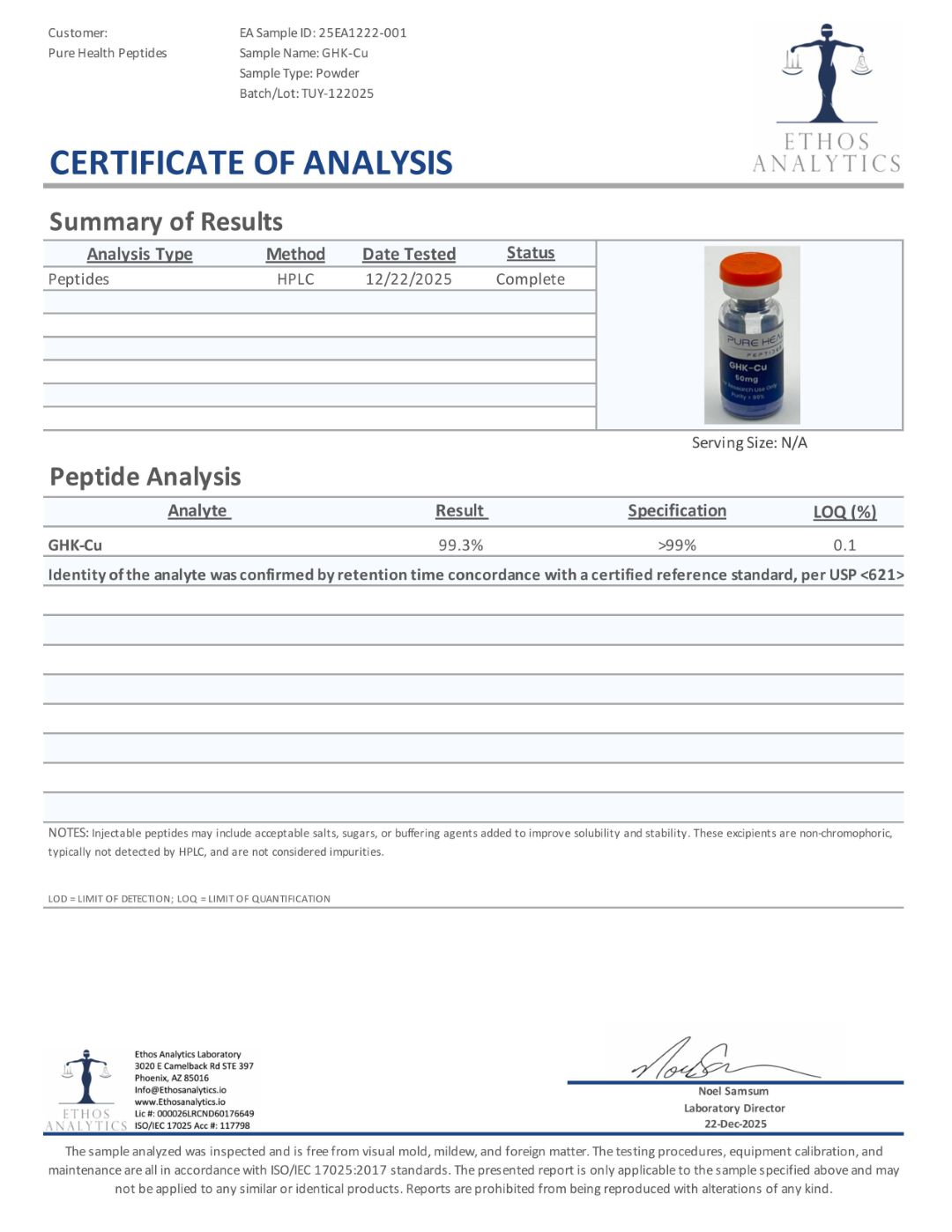
- The chromatogram is the most crucial visual data component on an HPLC peptide examination record.
- Asparagine and glutamine residues can undergo deamidation, transforming the peptide's charge and hydrophobicity.
- Throughout solid-phase synthesis, each amino acid coupling step has a yield of about 99-- 99.8%.
- This is the gold standard for peptide identification-- it validates both the make-up and the series.
Peak Lab Content Group
For researchers, getting confirmed peptides isn't just a procedure-- it's the structure of dependable experiments and research study reproducibility. Poor-quality peptides (those with unnoticed impurities, incorrect series, or degraded parts) can cause misleading data and irreproducible results. As a matter of fact, proteins and peptides are among one of the most commonly used lab reagents, yet research studies have revealed that their quality is usually insufficient, causing bad data reproducibility. Beginning with proper lab validation is consequently a vital part of a scientist's quality control workflow.
The pureness of peptides is generally evaluated making use of high-performance liquid chromatography (HPLC). HPLC separates peptides based upon their communications with a stationary stage, allowing impurities and spin-offs to be identified and measured. Furthermore, mass spectrometry (MS) can be used to validate the peptide's molecular weight and series, offering additional confirmation of pureness by finding contaminants and degradation items. If you have actually ever obtained a synthetic peptide for a laboratory experiment, you've likely saw a pureness percent on the certificate of evaluation-- usually worths like 95%, 98%, or even 99%. Peptide purity is an important top quality metric that tells you what portion of a peptide example is the designated product versus unwanted spin-offs.Peptide Purity Analysis Service
It is more info an area-percent pureness measurement, not a total identity or task examination. Significantly, purity portions describe chemical structure only-- they do not show sterility or biological suitability. Peptides from Maxed Out Compounds are provided specifically for laboratory study use and are not meant for human or veterinary functions. Peptide pureness is normally shared as a percent, such as 95% or 98%. This https://jsbin.com/tivodegede figure stands for how much of the example is made up of the preferred peptide sequence. For many research laboratory applications, a purity of 95% or higher is considered research-grade.Together, these logical techniques give the proof base for wrapping up that a peptide batch is suitable for research use. Another associated term you might encounter is web peptide material, which is different from pureness. Net peptide material describes how much real peptide (by weight) is in the vial relative to non-peptide parts like water, counter-ions (e.g., TFA), or barrier salts.
Very couple of business research study peptide vendors provide MS/MS data on regular COAs-- it is generally scheduled for pharmaceutical-grade materials and advanced research settings. Nonetheless, some premium suppliers do give it on ask for essential sets. If series confirmation is vital for your research study, this is the evaluation to request. It divides the components of an example based upon their differential fondness for a stationary phase (column packaging product) and a mobile phase (solvent system moving through the column). Peptides, with lengthy molecular sequences and varied conformations, present difficulties for structure verification and content decision. BOC Sciences leverages high-resolution mass spectrometry, LC-MS/MS, and NMR to properly examine molecular frameworks and provide extremely delicate measurable assistance.
